



FAQs Answered About Submerged Arc Welding Flux
By TJ Sneeringer, Applications Engineer
Submerged arc welding or SAW is a common process used for welding thick, heavy weldments — 5/16 inches and more — as well as for applications with long, straight seams. For that reason, SAW is often used in pressure vessel and bridge component fabrication, plus heavy equipment manufacturing, in flat and horizontal positions. It can also be used to weld larger parts that are rotated during the process.
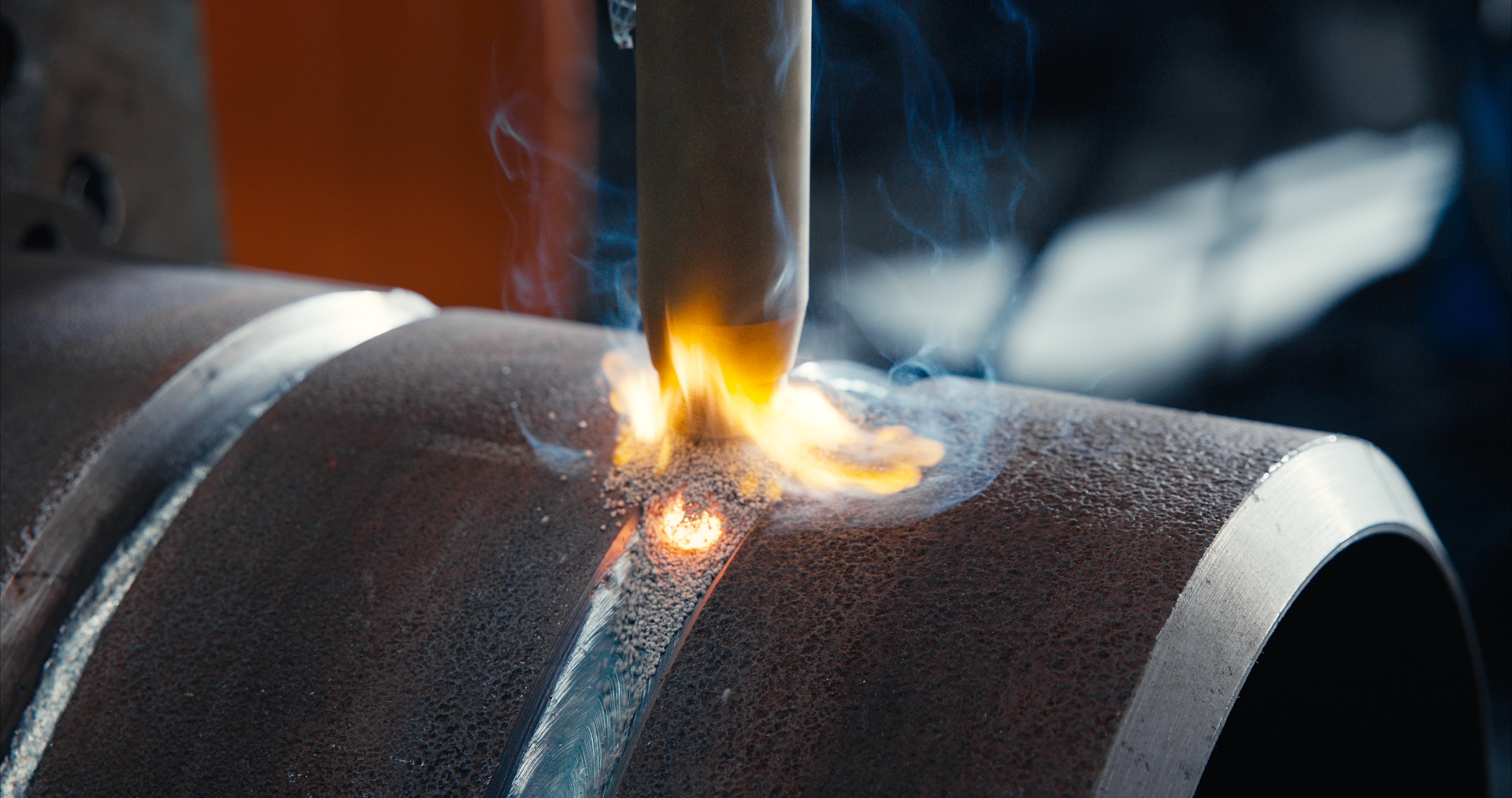
The SAW process, which operates by way of a continuously fed welding wire that is submerged under a blanket of flux, often offers the highest deposition rates of available arc welding processes. It is a repeatable process that supports consistent weld quality. Most importantly, SAW offers robust mechanical properties — tensile strength, yield strength and elongation — to create high-quality welds, plus excellent impact properties.
Understanding the role and types of flux for the SAW process is important to gain the best results. To help, here are answers to some frequently asked questions.
What role does flux play in the SAW process?
In addition to protecting the weld pool from contamination from the atmosphere and base material, flux also directly affects mechanical properties. When comparing gas metal arc welding (GMAW) and SAW wires with comparable tensile strengths — for example, a standard 70 ksi GMAW metal-cored wire like FabCOR® 86R to a SAW metal-cored wire like SubCOR® EM13K-S MOD — the SAW wire provides both improved tolerance to adhered mill scale and light rust, along with better Charpy V-Notch impact properties. The result is a porosity-free weld that can withstand harsher, lower temperature service conditions. Depending on the type, flux also affects the amount of weld penetration and weld bead contour.
What types of flux are available, and what are their characteristics?
There are three main types of SAW flux: active, neutral (low basicity) and neutral (high basicity).
As the name indicates, active fluxes more actively affect the chemistry of the weld compared to neutral fluxes, particularly in response to changes in voltage. Because of that, they are used for two weld passes maximum in fillet and butt welds. Additional passes are not recommended as they cause the weld to draw in too many elements, like manganese and silicon, from the flux. This enriches the weld’s chemistry too much and can lead to lower ductility and cracking. Note, however, that manganese and silicon in the appropriate amounts play an important role in flux, working as arc stabilizers and deoxidizers and allowing for welding through light rust and mill scale. Active fluxes are also good for increasing travel speeds and providing a flatter weld bead contour.
Neutral (low basicity) fluxes change the chemistry of the weld significantly less (but still to some degree) and are good general-purpose fluxes; however, they do not handle surface contaminates as well as active fluxes. They are generally not very sensitive to changes in weld parameters and do not have weld pass limitations.
Neutral (high basicity) fluxes provide virtually no alloy modification, as well as higher impact properties than neutral (low basicity) ones. They also provide a more convex bead appearance that is more pronounced at very high travel speeds. The better low-temperature impact properties make them well-suited for more critical welds.
What considerations affect flux selection?
When choosing a flux, consider the required mechanical properties and joint design. It’s imperative that the weld can provide the strength, toughness and ductility to withstand the service conditions it will encounter. For a general fabrication application that has thick weldments requiring multiple passes, choose a neutral (low basicity) flux. However, if higher travel speeds and greater productivity are the priority and only one or two passes are needed, an active flux is more suitable. If the weld will be subject to extremely low temperatures, a neutral (high basicity) flux is best.
What type of SAW wires are available to pair with different fluxes?
Solid SAW wires can be paired with active or basic fluxes. For example, Hobart SDX S2Si-EM12K solid wire is compatible with HA-495 active flux, as well as SWX 150 neutral high basicity flux. The decision on the wire/flux combination depends on the application. Using this solid wire with the HA-495 active flux would be appropriate for high-speed fillet welds or thinner butt joints. A metal-cored wire like SubCOR 120-S can be paired with SWX 150 basic flux to gain high-strength weld deposits with excellent low-temperature toughness in the as-welded condition. It provides good sidewall fusion and higher deposition rates compared to solid wires. For added versatility, SubCOR EM13K-S MOD, a metal-cored wire for carbon steel can be used with all Hobart fluxes. Hobart also offers hardfacing wires for SAW in combination with HF-N flux.
Can Hobart SAW wires be paired with other brands of flux?
Hobart formulates its fluxes to operate specifically with Hobart wires and classifies the pairings according to American Welding Society (AWS) specifications. It is not recommended to combine Hobart fluxes with a different brand of wire and vice versa. Contact the Hobart Application Engineering Department with questions about the combination of wire and flux that can provide the required mechanical properties, desired weld bead appearance and optimal productivity levels. Call 800-532-2618 or email [email protected].