


Know Which Weld Steel is Best for Your Project: 4130 vs 4140
Many heavy equipment applications call for materials that can withstand tough, demanding conditions. These include the fabrication and repair of shafts, gears, and forgings. AISI/SAE 4130 vs 4140 low-alloy steels are often chosen for these jobs. Their chemical composition enables heat treatment to high tensile strength and hardness.
The AISI/SAE 4130 and 4140 specifications cover a chemical composition range only. They do not define mechanical property ranges. Both grades contain carbon, chromium (0.80 to 1.15 percent), and molybdenum (0.15 to 0.25 percent) as primary alloying elements. They differ slightly in carbon content. 4130 has a nominal 0.3 percent carbon, while 4140 has a nominal 0.4 percent.
The strength of both materials depends on the thermal treatment applied. Common treatments include annealing, normalizing, quenching, and tempering. Flame hardening can also harden the outside of these materials while keeping the interior relatively soft.

Their strength makes 4130 vs 4140 steels well-suited for components such as gears that require high strength and durability. However, the higher carbon, chromium, and molybdenum levels that make these materials strong also increase their susceptibility to cracking.
Consider the common challenges and best practices for welding 4130 vs 4140 steels. These apply to both new fabrication and repair welding, and the right filler metal is key to success.
Tips for welding 4130 vs 4140 steel
Many challenges and best practices are the same whether welding new material or making repairs. Consider these six important steps when welding or repairing 4130 and 4140:
Identify thermal treatment. Welders typically perform new fabrication on material in the annealed or normalized condition. Do not weld 4130 or 4140 steel in the quench and tempered or case-hardened condition. First anneal or normalize the weld area.
Select a filler metal. The right filler metal depends on the material condition before welding, the component design, and the desired condition after welding.
For as-welded or post-weld stress-relieved conditions, filler metal selection commonly focuses on matching the base metal’s as-supplied tensile strength. Welders typically choose a low-alloy filler metal that differs in chemistry from the 4130/4140 base material. It should still provide suitable mechanical properties in both the as-welded and PWHT conditions. Some components need multiple repairs, each requiring a post-weld stress-relief cycle. In those cases, confirm the filler metal will maintain its properties after the total cumulative stress-relief time.
Under-matching the base metal tensile strength — using a weaker filler metal — improves weld metal ductility and fatigue life. However, the weld may not resist the high stresses that some component designs require.
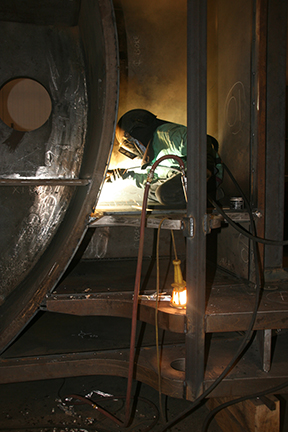
and 4140 steels are commonly used in heavy
equipment applications, including for shafts,
gears and forgings.
Overmatching tensile strength — choosing a stronger filler metal — is generally not recommended. The added strength reduces ductility and increases crack susceptibility in the weld metal.
When annealing or normalizing welds after welding, use a 4130 or 4140 filler metal for best results. These filler metals produce a brittle as-welded deposit, but annealing or normalizing resets the microstructure. This restores ductility in both the weld metal and heat-affected base metal.
Welds to be quench and tempered after welding require a 4130 or 4140 filler metal. Most low-alloy filler metals of sufficient tensile strength lack the carbon needed to respond properly to quench and tempering.
Heat Management for 4130 vs 4140 Welds
Apply preheat. The high hardenability of 4130 and 4140 steels means a hard, brittle microstructure can form in the heat-affected zone. Preheating is necessary for consistent, high-quality welds.
Maintaining a minimum preheat and interpass temperature slows the weld cooling rate. This prevents or minimizes the formation of brittle microstructures. Use sufficient preheat temperatures — typically 550 to 800 degrees Fahrenheit for thick components. Heat through the entire base material thickness, not just the surface. Using induction heating can help efficiently achieve proper heating throughout the part. Establish the preheat temperature at least 3 inches from the weld joint in all directions. Larger weldments may benefit from an even greater preheat area around the weld joint.
Perform welding. Low heat input can accelerate the weld cooling rate, causing brittle microstructures to form. This harms ductility and toughness. Raise heat input by increasing voltage and amperage, or by slowing travel speed. Consider these variables when developing a welding procedure for 4130 and 4140 steels.
Slow cooling. After welding, hold the weldment at preheat temperature, then cover it in ceramic insulation. This allows hydrogen to diffuse out of the weld metal and the heat-affected zone (HAZ). Hold for 30 minutes to an hour per inch of base material thickness. This process is informally known as hydrogen bake-out, and it is different from post-weld stress relief.
Apply post-weld thermal treatment. Post-weld heat treatment relieves welding stresses that could contribute to cracking. Releasing these residual stresses before machining also helps maintain tight tolerances. Thin material (less than 1/8 inch) typically does not need stress relief. Stress relieve thicker materials at 1,050 to 1,250 degrees Fahrenheit for about one hour per inch of thickness. Always account for the times and temperatures of any post-weld thermal treatment. Confirm that your chosen filler metal will maintain adequate mechanical properties throughout.
Tips for repairing 4130 vs 4140 steel
Repairing 4130 vs 4140 steel is often more complicated than new fabrication. The component may be worn, greasy, or dirty. Finding information on the material’s prior thermal treatment can also be challenging.
Always consult the original equipment information for guidance. This helps you understand any thermal treatments or design requirements of the component. It’s critical to identify how the part received heat treatment before completing a repair. Identify whether the part underwent annealing, normalizing, quench-and-tempering, or flame hardening. A quenched and tempered part is less ductile and more crack sensitive, making repairs much more difficult. Localized annealing or normalizing around the weld before repair can help, but it will affect material strength. Use a hardfacing product if surface hardness is a primary consideration. To restore base material strength, apply thermal treatment after the repair.
Properly preparing the material before repair helps ensure high weld quality. Welding over oil or grease can cause porosity in the weld metal. It also introduces diffusible hydrogen into the weld deposit, increasing the risk of hydrogen-induced cracking. Simply removing visible oil and grease may not be enough. Instead, consider steam degreasing to remove contaminants trapped deep within the base material pores.
Specific 4130 vs 4140 Repair Types
Crack repair: Crack repairs present significant challenges regardless of base material. Repairs often suffer from higher joint restraint, which introduces additional stress and increases the risk of cracking. Before attempting repairs, perform dye-penetrant (PT) or magnetic particle (MT) inspection to identify the full extent of the crack.
Remove the cracked area using grinding or an arc-gouging process. Shape the removed area into a wide “V” or “U” to prevent lack of fusion or solidification cracking. Use preheat during arc-gouging for the same reasons you use it during welding. Drill both ends of the crack to minimize the risk of it propagating during repair. Before welding, confirm complete crack removal using PT or MT. After this preparation, you can begin welding.
Build-up and overlay: This type of repair restores components to their original dimensions. For overlay repairs, it applies a deposit with hardness comparable to quenching and tempering or case hardening. Overlay products tend to be harder than build-up products but often have thickness limitations. Build-up products typically have no such restriction. Beyond a certain number of layers, overlay deposits lose ductility. They may become crack sensitive or splinter from the base metal. Use build-up products when the thickness to restore exceeds what an overlay product allows.
Closing thoughts
4130 vs 4140 steels have high hardenability. Three factors are critical for welding success: filler metal selection, hydrogen control, and cooling rate. Follow these best practices for heavy equipment applications.
1. Verify all design requirements and base material thermal treatment before welding.
2. Choose a filler metal that provides sufficient mechanical properties for parts left in the as-welded or stress-relieved conditions.
3. For components to be annealed, normalized, or quench-and-tempered after welding, match the filler metal chemistry to the base metal.
4. Select a minimum heat input and preheat/interpass temperature to help slow the weld cooling rate.
Related Articles:
Filler Metal Selection and Heat Input Recommendations for Low Alloy Steel