


Fabricator and Contract Manufacturer Improves Quality and Productivity with Metal-Cored Wire
Originally published on | Updated on
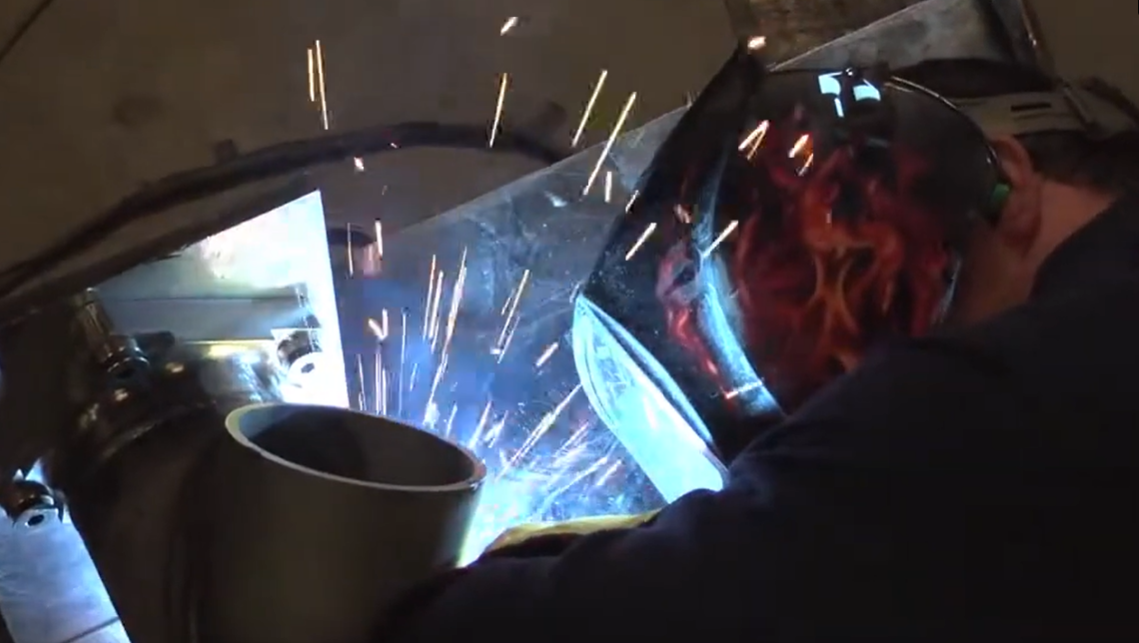
Swartfager Welding, Inc. of Knox, PA was able to improve its quality on pipe applications by using Hobart Brothers metal-cored wire with a Pulsed welding process. Metal-cored wire eliminated spatter, distortion and other discontinuities that could lead to downtime.
Video Transcript
Five or six years ago, our pipe fabrication load started to pick up. We went from TIG welding a root pass on everything we made, and we still do a lot of that. Bare wire cover just wasn’t good. It didn’t look good. You had spatter issues, and a multitude of problems that were just hard to overcome or address. At first it was, “Okay, here’s metal core. It ran great when you turned it. Now we have to get out of position with it.” And that led to pulser boxes and a whole plethora of things that we had to work through in the beginning. And then that led us into the PipeWorx and the new style and the new mindset of equipment.
When you’re dealing with high-pressure piping or just something as simple as low-pressure water piping, your weakest link is always your weld joint. That’s always where your material characteristics vary and everything changes. Metal core allows us to take just about any type of piping or tubing and produce a joint that is structurally and visually better. It gives us the ability to weld out of position and still keep joint integrity. It all comes down to heat input and distortion. When our fabrications come out of our tooling, we don’t want to machine them ever again. We want to put a machine endpoint in on both ends or whatever the job requires. And when we pull it out of the tooling, we don’t want pull in the part. We don’t want extra shrinkage we couldn’t calculate. And metal core allows us to control all of that. Now we don’t have to unfixture a pipe to complete it by rolling it, where we could go out of position with the same wire we’d become accustomed to liking, and get the same results.
It increases probably by 30 or 40%. We get an increase in production during the day because we don’t have to go back and grind all the spatter off of pipe. We don’t have to worry so much about the fit up being perfect on the root pass because metal core allows you to sidestep and actually make it all look like one nice fillet. For pipe welding, it’s what everybody should be running. We haven’t switched the robot away from metal core since the first day we hung it on it. We’ve never changed out the wire. We run it on everything that goes into the cell. There is a way to use metal core to do the job. You can use the same wire and the same robot for your root pass and cover pass. You can use it for everything and anything. It seam tracks just as well as anything else. It touch senses without trouble. We haven’t had any trouble with it.
We’re qualified to run a TIG root pass and metal core cover on eight different marine shipping bureaus worth of piping standards. We’re through some of the easiest would be like BV through German Lloyds. If anybody knows about German Lloyds, that’s one of the most painstaking things in the world to get a stamp for. We have four or five guys qualified for all of those shipping bureaus where we can provide oil and water critical piping systems for engine packaging on a boat, where it’s all good to go. Metal core is our defined method that got us there. Anybody can run a root pass, but when you give them a cover that they can cut apart, sample, and X-ray, and they can’t find a flaw, it made it a lot easier to get certified. It took our certification window from normally 18 to 36 months down to about four because every time they sampled our stuff, they couldn’t find anything to balk at.